



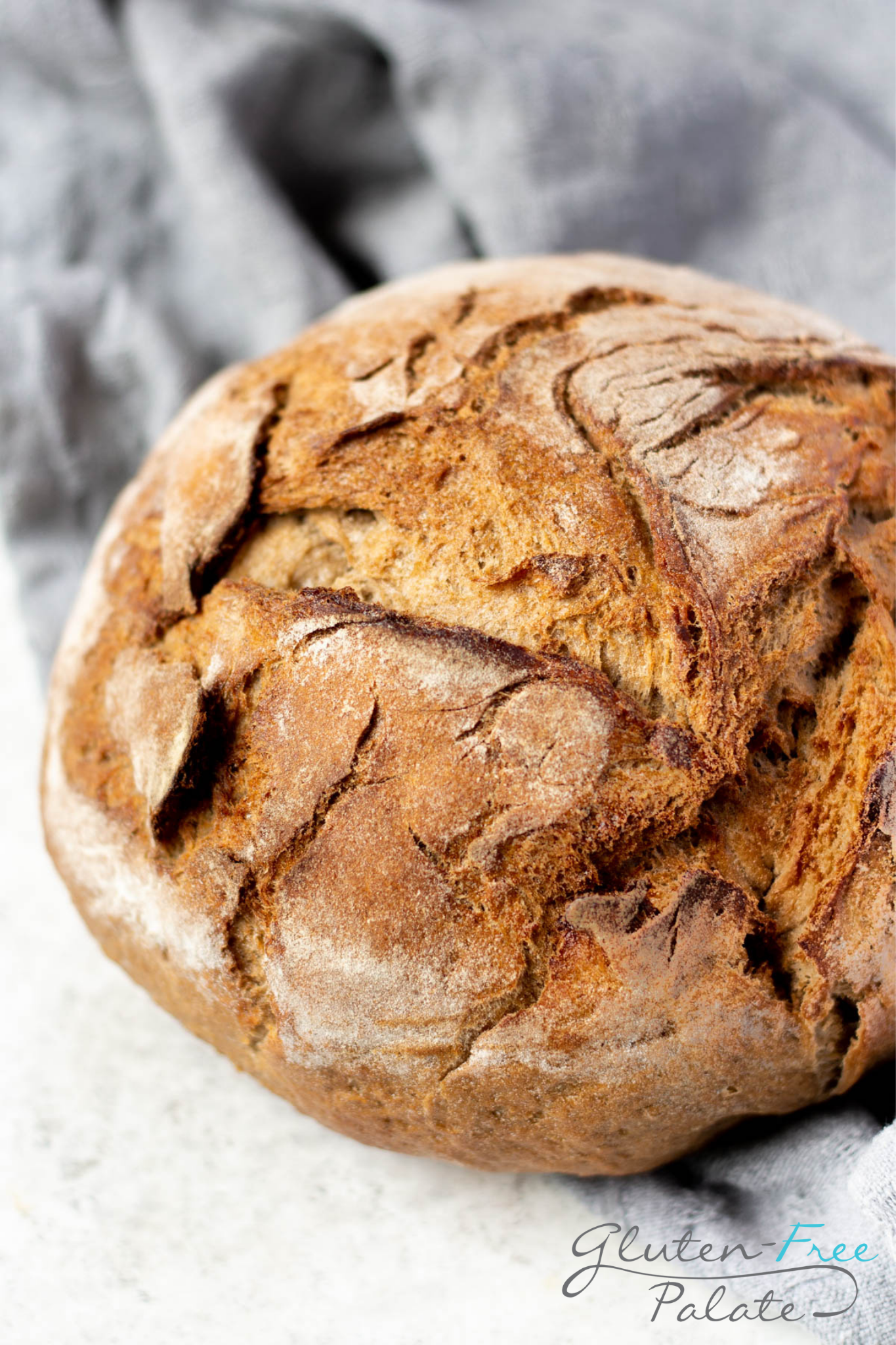
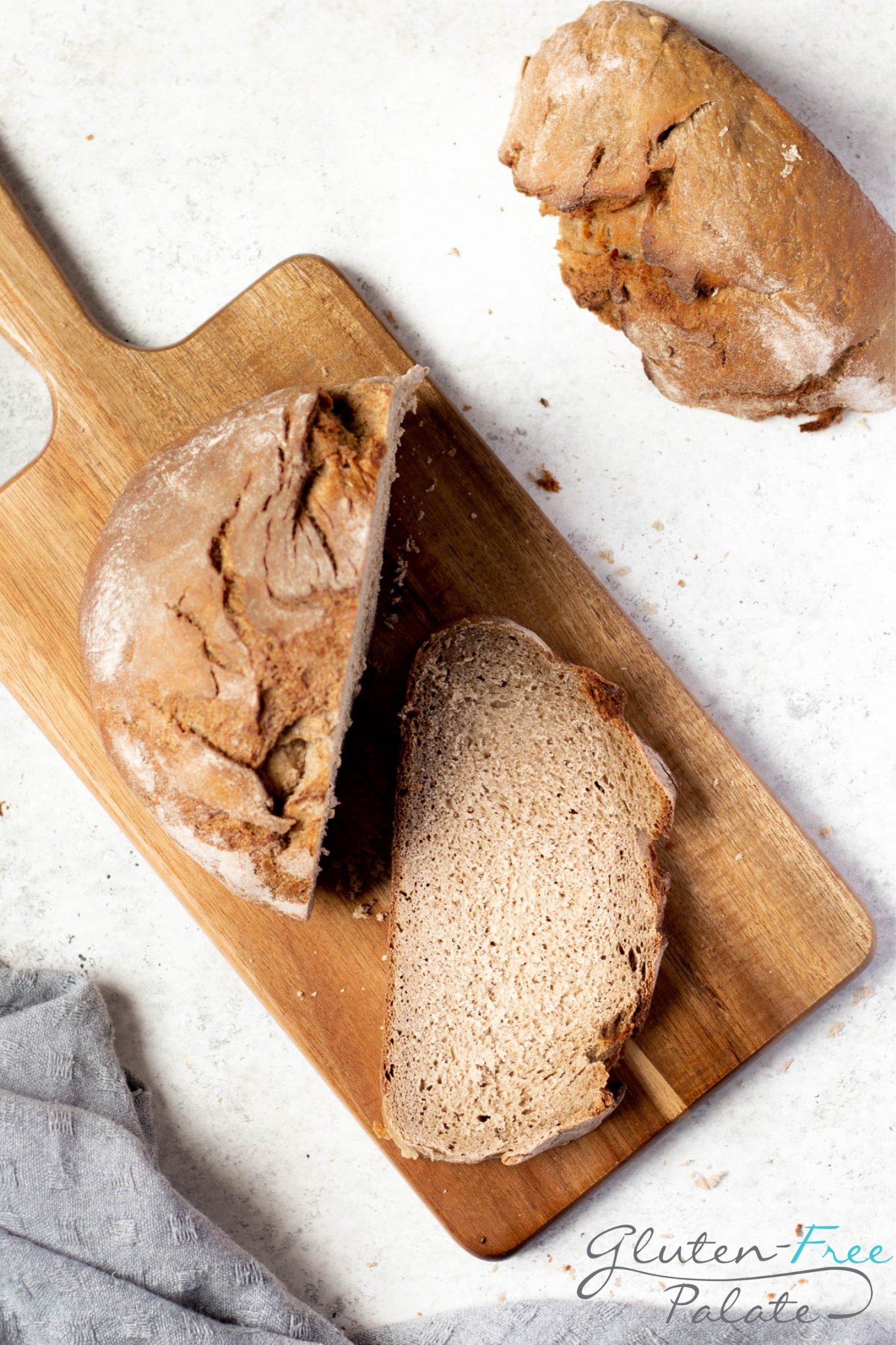
If you're a fan of our tried and tested gluten-free bread recipe, you are going to be thrilled about this new recipe for gluten-free sourdough bread! While our other bread recipe is meant to bake in a bread machine or a loaf pan, this one makes a beautiful free-form rustic loaf.
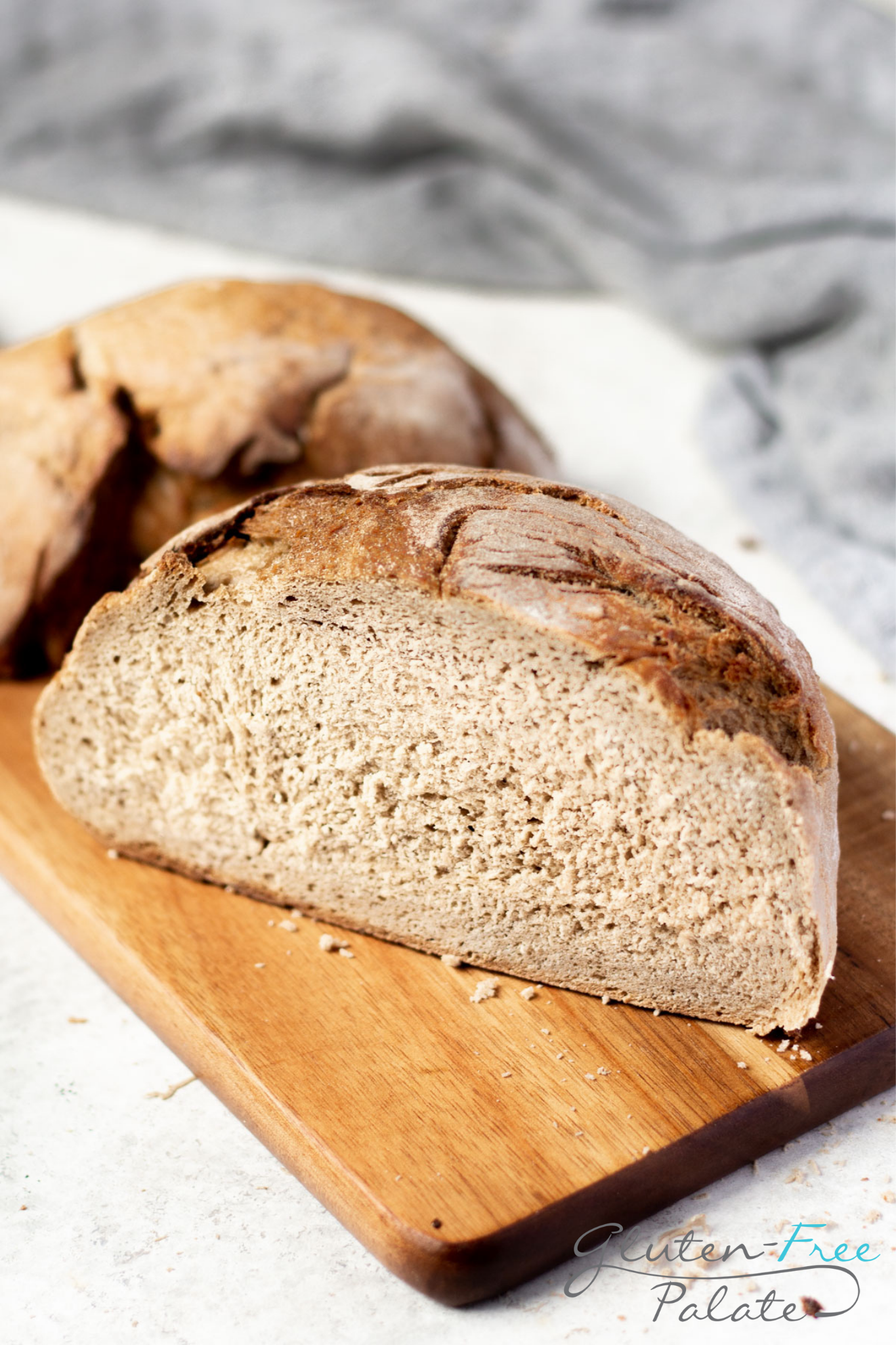
Your sandwiches will be heavenly on slices of this tangy, chewy, homemade sourdough. Learn all of our best tips and tricks for making the perfect sourdough bread gluten-free.
Looking for more gluten-free bread recipes? These gluten-free rolls are light and fluffy. They're a perfect dinner side (and delightful around Thanksgiving). But my all-time favorite is this gluten-free bread recipe you can make in the oven or in a bread machine.
Gluten-Free Sourdough Bread Recipe
Making bread, and especially sourdough bread, is really an art form. I loved starting the process off by making my very own sourdough starter from scratch. Learning all the ins and outs of the starter is a really interesting process. Waiting 2 weeks until I could use it was not fun.
Once the wait for the starter was over, I immediately had no time to waste. I made this recipe with a few tests and then perfected it more each time. And best of all, because normal sourdough isn't an option for anyone with Celiac disease, this gf recipe is exactly what we've been waiting for.
So get your sourdough starter ready or ask a friend for some and follow these steps for a truly amazing gluten-free sourdough bread that is so rewarding to make and even better to eat with a slathering of butter.
Why You’re Going to Love This Gluten-Free Sourdough Recipe
Making your own bread is so rewarding: There is nothing more rewarding than making your own homemade bread and marveling at it once it is out of the oven.
Tastes so good: I personally prefer the taste of homemade bread more than store-bought.
Just simple ingredients: You know exactly what you have placed in your homemade bread, so no added nasties. No commercial yeast (or honey, or maple syrup) either.
Ingredients In Gluten-free Sourdough Bread
Sourdough Starter: In order to make this bread, you'll need an active gluten-free sourdough starter. The starter provides yeast and also the characteristic sour flavor you want in a sourdough loaf. See the recipe card or the instructions above to learn more about this process. The best-case scenario is either you've made one with buckwheat flour yourself (using my starter recipe), or that you know a friend with a similar gf starter.
Warm Water: You don't want the water to be too hot or too cold when you're working with sourdough yeast. Tepid, lukewarm water is ideal for making dough. Also, use filtered water.
Instant Yeast: This might not be entirely necessary, and I know that it sort of defeats the purpose of using a natural yeast source to make sourdough, but I add it in to be extra sure that this bread gets a good rise and has lots of airy texture. Gluten-free bread needs all the help you can give it sometimes!
Sea Salt: To give the bread a bit of flavor.
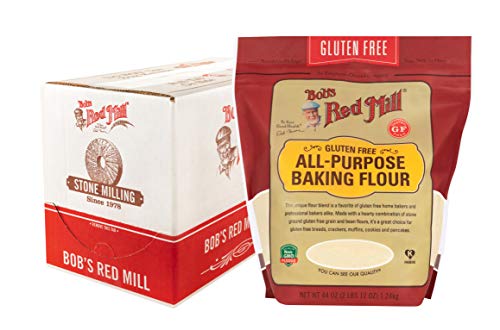
Gluten-Free All-Purpose Flour: This has been tested using our gluten-free flour blends, King Arthur's Gluten-Free Measure for Measure Flour, and Bob's Red Mill All-Purpose Gluten-Free Flour (plus 2 tablespoons of xanthan gum). You can experiment using other flours or blends, but you may come out with different results.
Xanthan Gum: Only add this if your flour blend doesn't already include it. Some, like the King Arthur brand, have added it for you already! And if you don't want to use this, you can use psyllium husk powder instead. Both accomplish the same goal of keeping your bread together!
Equipment Needed for This Gluten-free Sourdough Bread Recipe
To make this simple, rustic loaf of bread, you don't really need any fancy tools. As you get more and more into bread baking, you may want to look into some of these specialty equipment:
- Danish Dough Whisk - Instead of using your hands or a wooden spoon to mix the dough, this tool was made especially for the job!
- Dutch Oven - You can bake a loaf of bread on a metal baking sheet, but if you'd like an extra crusty loaf, you'll want to try baking it in a 5-6 quart Dutch Oven instead. The lid is what helps trap in the moisture, so the crust turns out so well.
- Banneton Basket or a large glass bowl - This is where your bread will rest to proof before baking.
If you have any questions about making gluten-free sourdough bread, please leave a comment and we will get back to you as soon as possible.
How To Make Gluten-Free Sourdough Bread
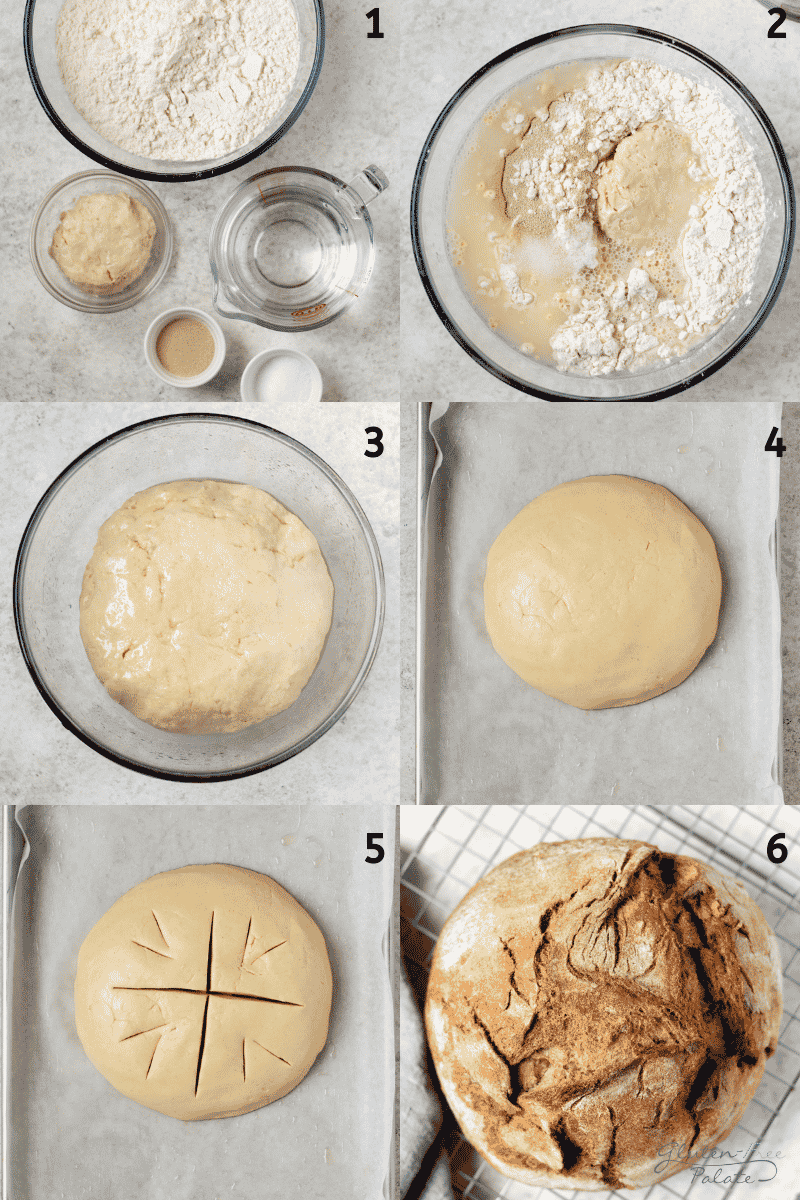
Here's the step-by-step version of the recipe. I've got these included in short form on the card at the bottom of this page, but I wanted to expand on them here.
1. Combine all your ingredients in a large bowl. Mix, then knead to form a smooth sourdough bread dough.
Add everything to a big bowl and mix until combined. You can do this in the bowl of a stand mixer. Just use a dough hook and mix slowly. Then knead into a smooth dough. Gluten-free dough will feel softer and less elastic but should hold together.
2. Place the dough in a lightly greased bowl and cover it with a kitchen towel. Let the dough rest for 2 hours in a warm place until it's double in size.
Put the dough in a greased bowl, cover, and let it rise in a warm spot. It should double in size with nice air bubbles.
3. Shape the dough by pulling the edges into the center. Turn it over, so the seam is on the bottom of the dough. Form a ball and then let the dough rest for another 15 minutes.
Fold the edges in, flip it seam-side down, and shape it into a ball. Let it rest uncovered for 15 minutes.
4. Preheat the oven to 400°F/200°C while the dough rests. Preheat the oven fully so the bread rises well and gets a good crust.
5. Place the ball of dough on a lightly greased, parchment-lined baking sheet. Dust the top of the dough with flour, and use a sharp knife to cut into the top of the loaf. This will allow the loaf to expand and create crispy ridges on the crust.
Set the dough on a parchment-lined sheet, dust with flour, and score the top to help it expand and form a crisp crust.
6. Bake for 30 minutes at 400°F/200°C. Then reduce the heat to 350°F/180°C and bake for 30 minutes more, until the crust of the bread is a dark golden brown. Bake for 30 minutes, lower the heat, then bake another 30 until dark golden brown and hollow-sounding when tapped.
That's it! You've made a delicious gluten-free sourdough.
The Importance of Sourdough Starter
Follow my full instructions on our Gluten-Free Sourdough Starter recipe page.
If you know anything about making traditional sourdough bread, you probably understand that the key ingredient, and the thing that makes sourdough what it is, is a good sourdough starter.
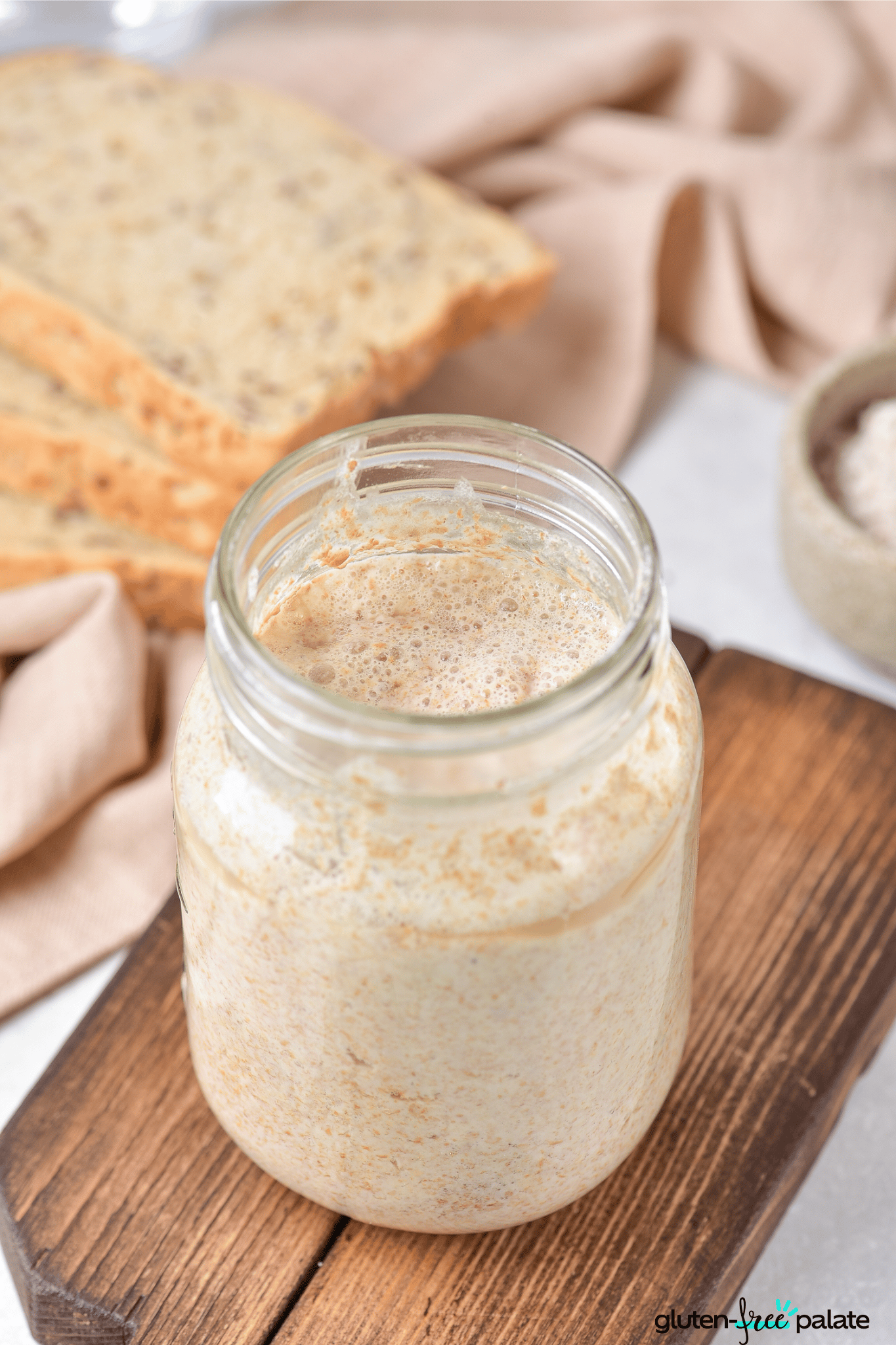
For a normal sourdough starter, this involves mixing wheat flour and rye flour together with water and leaving it out to collect wild yeast spores. You feed this yeast on a schedule in order to keep it alive and available for baking.
You can get some gluten-free sourdough starter from a gluten-free friend, or you can ask at your local wheat-free bakery. And note that the way you care for your starter will make a big impact on the taste of your bread. Seriously. Studies like this one prove it!
It might be easier to make your own sourdough starter if those options aren't available to you, though. The full gluten-free sourdough starter recipe will be below, but here's the basic idea.
You may need 1-2 weeks to get a strong, working gluten-free sourdough starter, so plan ahead. be kept alive and working for a very long time for sourdough bread baking.
At room temperature, you'll need to feed the sourdough starter every 24 hours or so.
You can also store the starter in the fridge in an airtight container. At the cooler temperature, it only needs to be fed once weekly.
These numbered steps match the numbered photos above and are for illustration purposes. For the complete list of ingredients and instructions for gluten-free sourdough bread, please see the complete recipe below.
Tips For Making This Recipe
Feed your gluten-free sourdough starter. Feed your starter at least 4-12 hours before making this sourdough bread recipe.
Follow the recipe. I would suggest sticking to the recipe. It is a tried and trusted recipe.
Use a kitchen scale. If possible, use a kitchen scale to get the correct grammage for the ingredients in this sourdough bread recipe.
Use a mature sourdough starter. Make sure the sourdough starter you use is about 2 weeks old. Preferably longer.
Make sure your bread bakes through. You do not want a gummy loaf, so make sure the bread is at 210 degrees F.
Let the sourdough dough rise. Let the dough rise until it is double in size. No need to use bulk fermentation, which is when you let the dough rise for 6-10 hours.
Frequently Asked Questions
Can Sourdough Bread Be Gluten-free?
Yes! We wouldn't be showing you this easy recipe if a delicious gluten-free sourdough bread weren't possible. Not only is it possible to make gluten-free sourdough, but it's also actually easy and fun too!
We are skipping the wheat flour as always, and we have tested this recipe using different varieties of all-purpose gluten-free flour and are very pleased with the resulting loaves.
This recipe for gluten-free sourdough bread has a dense, fluffy crumb and is super simple to make.
How Do I Store Gluten-Free Sourdough?
Try to enjoy your sourdough bread when it's fresh. I know you'll want to after you smell it baking, and that's when it's the most delicious!
Any leftovers can be wrapped up and stored on the counter for a few days. Older bread is delicious when toasted and topped with jam.
What Variations And Substitutions Can I Make In This Gluten-Free Sourdough?
We've made this recipe simple on purpose. Are there other flours that might work better? Maybe, but we didn't test them here. If you want to make substitutions in the recipe, feel free, but understand that it will be an experiment.
Come back and let us know how different flours worked for you, please!
Can I Make Dairy-Free, Gluten-Free Sourdough?
Sourdough bread is a dairy-free food! Enjoy this bread recipe that is both gluten and dairy free.
Is Trader Joe's Sourdough Bread Gluten-free?
No, Trader Joe's sourdough bread is not gluten-free.
Is Gluten-Free Sourdough Bread Healthy?
Yes, it is. Microflora in sourdough bread has benefits as it increases your body's ability to absorb vitamins and minerals. It is nutrient-dense, easier to digest, and has a lower glycemic index.
How Many Carbs Are In Gluten-Free Sourdough Bread?
This GF sourdough bread recipe has 114g of carbs in it.
Can You Make Gluten-Free Sourdough Bread Without A Starter?
Yes, you can. And no, it is not with a gluten-free flour blend. You could replace the starter with a milk kefir. However, I have not tested this recipe with these ingredients yet.
What Can I Do When My GF Sourdough Bread Is Gummy Inside?
Bake it until it reaches the correct temperature. Make sure your bread is at 210 degrees F before removing it.
Cool your bread. It is important to let your bread cool completely. I know how tempting it is to slice it immediately. Leave it for at least 6 hours.
Toast it. Toast your bread if it is gummy.
How Many Ppm Of Gluten Is In Sourdough Bread?
There has been some research into the differences between traditional yeasted bread and sourdough yeasted bread when it comes to gluten levels. The fact is that wheat-based sourdough bread has much less gluten in it than regular bread. This is because the dough goes through a process of fermentation where the bacteria in the starter actually start to break down the gluten in the flour.
Instead of the 80,000ppm of gluten that is in typical bread, sourdough bread has about 2,000ppm.
For this reason, there are some non-celiac, gluten-intolerant folks who can actually eat sourdough without negative reactions.
That said, I don't recommend that you risk it. Make this recipe instead, so you can be sure that there is NO gluten in your sourdough at all.
Gluten-Free Sourdough Bread
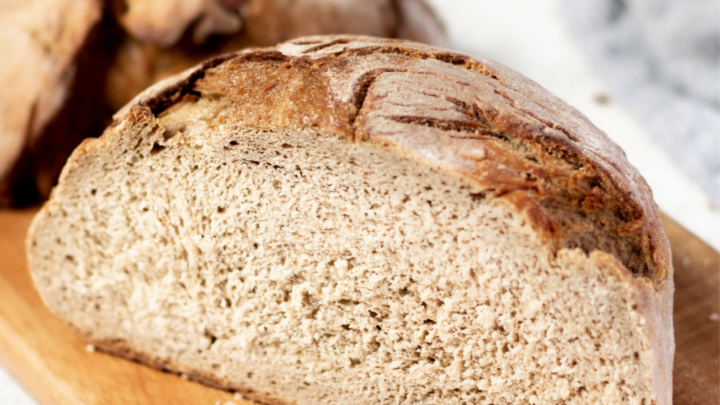
Your sandwiches will be heavenly on slices of this tangy, chewy, homemade sourdough. Learn all of our best tips and tricks for making the perfect sourdough bread gluten-free.
Ingredients
For the Starter:
- 1 cup gluten-free flour (about 120g King Arthur’s Measure for measure gluten-free flour)
- ½ cup cool water
For the Sourdough Bread:
- 1 cup ripe gluten-free sourdough starter (about 230g)
- 1 ½ cups warm water
- 2 teaspoons instant yeast
- 2 teaspoons sea salt
- 5 cups gluten-free all-purpose flour (about 600g King Arthur GF Measure for Measure)
- Optional : 2 tablespoons Xanthan Gum - Only if your flour doesn't include any.
Instructions
Sourdough Starter
- To Make Gluten Free Sourdough Starter: Combine 1 cup flour with ½ cup cool water. Cover and allow to sit at room temperature overnight. Each morning for 5-10 days, remove and discard half of the starter, then feed with another cup of flour and ½ cup of water.
- You will know that the starter is ready when it is very active and will double in size in a couple of hours.
Sourdough Bread
- Combine all your ingredients in a large bowl. Knead to form a smooth dough.
- Place the dough in a lightly greased bowl and cover with a kitchen towel. Let the dough rest for 2 hours in a warm place, until it's double in size.
- Shape the dough by pulling the edges into the center. Turn it over so the seam is on the bottom of the dough. For a ball and then let the dough rest for another 15 minutes.
- Preheat the oven to 400°F/200°C while the loaf rests.
- Place the rested dough on a lightly greased parchment-lined baking sheet.
- Dust the dough with flour. You can optionally make some cuts into the dough, using a sharp knife.
- Bake the bread for 30 minutes at 400°F. Then reduce the heat to 350°F and bake for 30 more minutes, until the bread is a very deep golden brown. Remove it from the oven and cool on a cooling rack.
Notes
- We have provided metric amounts for the flour in this recipe, but please note that the grams will be different depending on the brand or blend of flour that you're using.
- You can make your own sourdough starter, or get some from your local wheat-free bakery or a gluten-free baker friend.
- For an extra crusty loaf, bake the bread in a Dutch oven that you've preheated in a 400-degree oven. You'll still put the pan in the oven to bake, but pre-heating it makes it work so much better.
Recommended Products
As an Amazon Associate and member of other affiliate programs, I earn from qualifying purchases. They never cost you extra.
-
 Bob's Red Mill Gluten Free All Purpose Baking Flour, 44-ounce (Pack of 4)
 -
King Arthur, Measure for Measure Flour, Certified Gluten-Free, Non-GMO Project Verified, Certified Kosher, 3 Pounds, Packaging May Vary
-
Amazon Basics Enameled Cast Iron Covered Round Dutch Oven, 6-Quart, Blue
-
Zulay Kitchen 13-Inch Danish Dough Whisk - Wooden Danish Whisk for Dough with Stainless Steel Dough Hook - Traditional Dutch Whisk - Bread Whisk for Sourdough, Pizza, Pastry, Cake Batter


Nutrition Information:
Yield:
5Serving Size:
1Amount Per Serving: Calories: 547Total Fat: 2gSaturated Fat: 0gTrans Fat: 0gUnsaturated Fat: 1gCholesterol: 0mgSodium: 854mgCarbohydrates: 114gFiber: 5gSugar: 0gProtein: 16g
This nutrition info is based on the exact ingredients and brands that I used a the time. It may not be 100% accurate. Please check your ingredients nutrition labels.
Did you make this gluten-free sourdough bread recipe? Please leave me a comment below letting me know what you thought.
DID YOU MAKE THIS RECIPE?
Tag @glutenfreepalate on Instagram and hashtag it #glutenfreepalatebaker so we can see all the deliciousness!



Cheryl Lee Pokorny
I had the same result as other bakers. I am new to GF baking and making sourdough bread. I added the 5 cups of Bob Mills 1:1 GF flour mix that includes the xanthan gum so I did not add anymore. The mix was SO dry. I added a little more starter and more warm water until I could get it all incorporated. I placed it into a banneton basket and in a warm spot. It did not rise AT ALL after many hours. My yeast wasn't expired. My starter was bubbling over the edge of the jar so it was very active. I used filtered water. This was my 3rd attempt at making a loaf of GF sourdough bread. That is why I was drawn to your recipe adding yeast for a better rise. Still failed. Ugh!
Wendy Stoltz
Hi Cheryl,
You need to use an all purpose flour not the 1:1. Try it and lets us know how you go.
Monica
I tried this recipe yesterday for a friend of our daughter who is celiac and turned better that i thought. I used half of the ingredients .After two hours it had not increased maybe too cold or because some ingredients were less than initial amount but at the end left it on the counter the whole night. Today it looked nice but again dough feels really strange (first time using gluten free flower) backed in oven as described, came out very white to be honest and looked stall and very disappointed but once we cut it it was really soft inside. I also tried it with butter and must confess the challenge was worth it and friend had a nice fresh bread for breakfast this morning. So worked for me this time even if not nice to look at . (looks really hard and heavy floured ) Thank you
Wendy Stoltz
Hi Monica,
It's wonderful to hear that you tried the gluten-free bread recipe for your daughter's friend and had a positive outcome! Baking with gluten-free flour can indeed feel different compared to traditional wheat flour, as gluten-free doughs are often more sticky and less elastic. The fact that your dough didn't rise much initially could be due to the temperature or the halved ingredients, but it's great that leaving it out overnight did the trick.
Thanks,
Katie Wilson
I tried your recipe twice without any good luck. Both times they turned out not fully cooked and they did not rise. Would you please give me some tips to help with a successful bread. I am new to baking my own bread, being gluten free is challenging on its own, finding bread that takes good is also difficult. Would love to know how to do this recipe and get the best results.
Thanks
Jim
Replied to you just now. I'd recommend reducing your liquid a bit to see if it helps!
Katie Wilson
Hello Wendy
I have used your recipe for Sour dough bread. I have a gluten intolerance and have been looking for a recipe to use for sour dough bread.
Unfortunately I have had no luck with this recipe. I am using unfiltered water that is temped with the correct amount measured with a kitchen scale. I let it rise though the dough did not double in size. Then baked it at the required temperature for the correct time. The bread came out almost a white color and very hard as well as under baked. Please let me know what I am doing wrong.
Thanks
Jim
Thanks for the question! I'd try reducing the liquid a bit or trying a different flour blend. Please let me know if this helps!
Vicki
If I have a mature gluten-free starter, do I actually need to add the starter mentioned at the beginning of the recipe?
Jim
You can swap in your own starter instead!
Bryan Callon
5 cups of flour or 600g are the amounts in the recipe ? 1cup = 227g which amount is correct
Thanks
Bryan
Jim
The recipe is correct: 1 cup is 129g for the King Arthur's measure for measure flour, so 5 cups is 600 grams. Note that this differs from other kinds of flour. This weight is specifically for the one used in the recipe. You can see the weights for their flours at King Arthur.
Cathy
Hello! Any recommendations for high-elevation adjustments? We are still relatively new to living at just above 5,000 feet and never quite know what to expect with new recipes. The starter process is my main concern. Thank you!
Jim
That's such a good question. We haven't tested this in higher elevation, but a good starting point would be an extra tablespoon of water, reduced fermentation time, and a tiny bit (like an eighth of a teaspoon). Please let us know how yours turns out!