


This almond flour banana bread is soft, moist, and full of natural banana flavor with a tender crumb that keeps you coming back for more. Made with simple ingredients in one bowl, it's naturally gluten-free, grain-free, dairy-free, and paleo-friendly. Almond flour, which is just finely ground almonds, gives this bread more protein, healthy fats, and fiber than traditional banana bread, so it keeps you full longer and makes a satisfying breakfast, snack, or dessert.

Why You'll Love This Almond Flour Banana Bread
- No extra fuss. You only need one flour, so there is no need to measure or combine multiple dry ingredients. One bowl, a whisk, and a loaf pan are all it takes.
- Moist and keeps you full for longer. Almond flour creates a rich, tender texture that is more filling than traditional wheat-based banana bread, while the bananas add natural sweetness and moisture.
- Quick and simple. This is a one-bowl recipe that takes about 10 minutes of hands-on work, making it perfect for busy mornings or when you need a fast dessert.
- Fits different lifestyles. Gluten-free, grain-free, and easily dairy-free, so it works for paleo, low-sugar, and allergen-friendly diets without any swaps.
How Almond Flour Bakes Differently
If you are used to baking with a gluten-free flour blend or all-purpose flour, almond flour behaves differently and it helps to know why before you start.
Regular flour contains gluten, a protein that creates structure and traps air so bread rises and holds its shape. Almond flour has no gluten at all. That means the bread relies entirely on eggs and leavening agents (baking soda and baking powder) for structure and lift. The result is a denser, more tender crumb with a slight nuttiness that pairs naturally with banana.
Almond flour also carries more fat and moisture than wheat flour. That is why this banana bread comes out so soft and stays moist for days, but it also means you need less oil than you would in a traditional recipe. Too much liquid will make the bread gummy. The balance in this recipe accounts for all of that.
We also love our Gluten-Free Banana Bread made with a gluten-free flour blend. The kids love it with gluten-free chocolate chips. But when we are trying to lower the sugar in the house, this almond flour recipe takes center stage.
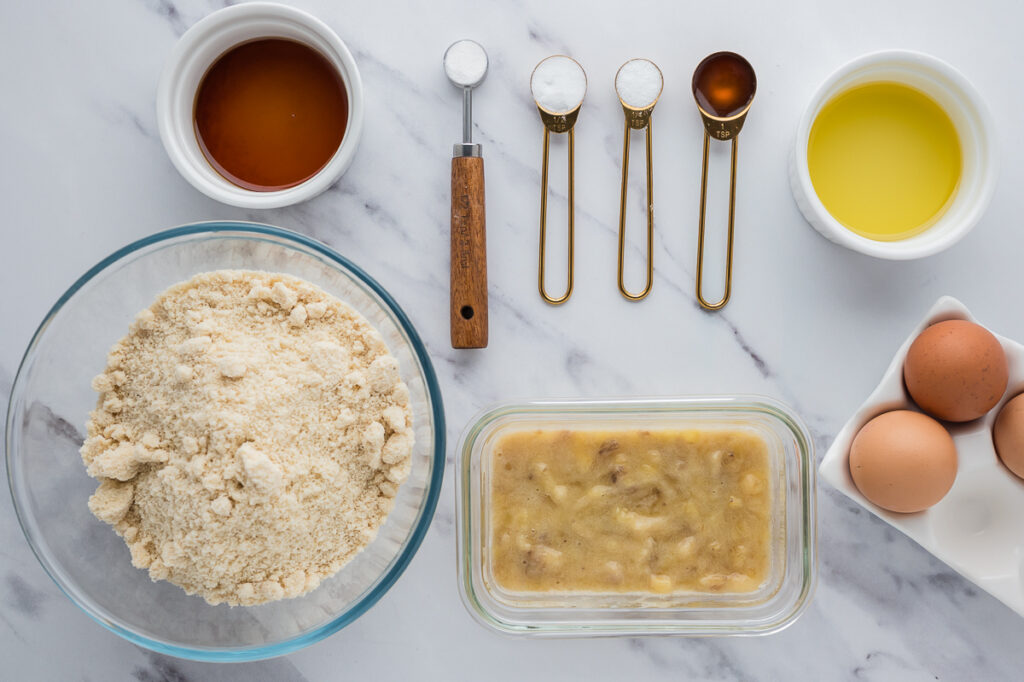
Ingredients in Almond Flour Banana Bread
Here is the base recipe. Scroll down for variations including chocolate chip, banana nut, vegan, and no-sugar options.
- Almond flour. Use finely ground blanched almond flour for the softest texture. Is Almond Flour Gluten-Free? Take a look at that article for the full breakdown on safety and sourcing. I do not recommend using almond meal (coarsely ground almonds with skins) because it can make the bread dense and slightly gritty. Almond flour is naturally gluten-free, grain-free, and rich in healthy fats and protein, which makes this banana bread more filling than traditional versions. You can also grind your own almond flour at home if you have a high-powered food processor, though store-bought blanched almond flour will give you the most consistent results.
- Whole eggs. Eggs provide structure and help the bread rise since almond flour does not contain gluten. They act as the main binding ingredient and help create a soft, tender crumb. Do not substitute with flax eggs in this base recipe (see the vegan variation below for that adjustment).
- Bananas. Use overripe bananas with brown spots for the best flavor and natural sweetness. Research published in the Journal of Food Science and Technology confirms that sugar content increases as bananas ripen, which is exactly what we want here. They add moisture and help bind the batter. I freeze my bananas when they start to turn, so be sure to thaw them, remove the peels, and let them come to room temperature before mashing.
- Oil. A neutral oil such as avocado oil, light olive oil, or melted coconut oil keeps the bread moist and tender. Using oil instead of butter also keeps the recipe dairy-free. Only a quarter cup is needed because almond flour already carries natural fat.
- Honey or maple syrup. These natural sweeteners add light sweetness and moisture while helping create a soft crumb. Either one works, so use what you have on hand. I have used maple syrup in this recipe, and it is sweet enough for our family.
- Baking soda. Baking soda reacts with the acidity of the bananas to help the bread rise and create a lighter texture.
- Baking powder. Baking powder gives the bread extra lift, helping it rise more evenly and preventing a dense loaf. Using both leavening agents together is important for almond flour baking because there is no gluten to trap air.
- Salt. Balances the sweetness and brings out the banana flavor.
- Pure vanilla extract. Adds warmth that works well with the banana and almond flour combination.
- Cinnamon (optional). A half teaspoon of cinnamon adds a warm, spiced note that pairs beautifully with banana. I like to include it when making this bread for breakfast. You can leave it out if you prefer a pure banana flavor.
Equipment Needed
- Large mixing bowl and whisk. We use one large bowl for the entire recipe.
- Measuring cups and spoons (or a kitchen scale). I prefer a kitchen scale for better accuracy with almond flour. If using cups, use the spoon-and-level method: spoon the flour into the measuring cup, then level it off with the flat side of a knife. Do not scoop directly from the bag, as this packs in extra flour and can make the bread too dense.
- Rubber spatula. Helpful for scraping down the bowl and getting all the batter into the pan.
- Metal loaf pan (9 x 5 inch). A standard metal loaf pan works best for this recipe. Metal conducts heat more evenly than glass or ceramic, which helps the bread rise and bake through without a gummy center. Line it with parchment paper or lightly grease it so the bread releases easily after baking.
- Wire cooling rack. Allows the banana bread to cool evenly and prevents the bottom from becoming soggy.
How to Make Almond Flour Banana Bread
This is the base recipe you can customize with chocolate chips, nuts, blueberries, or other add-ins (variations are listed below). The entire process is one bowl, start to finish.
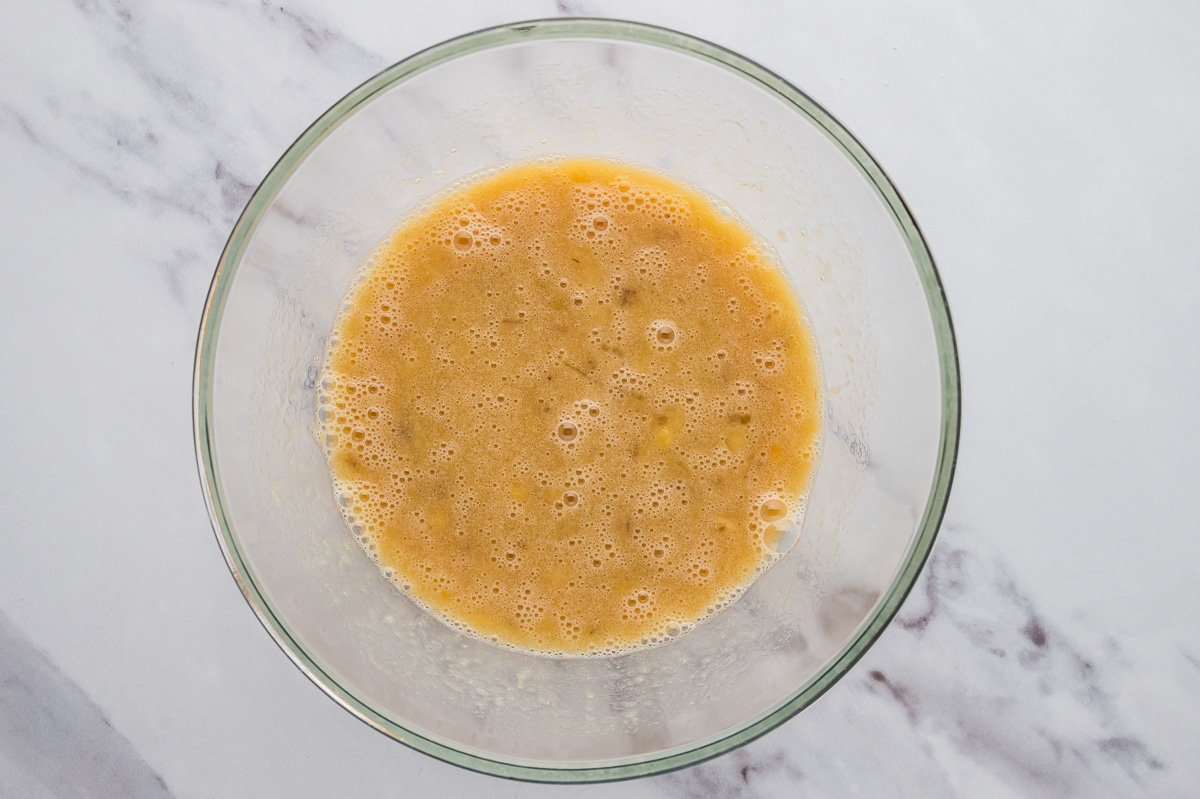
Preheat your oven to 350°F (175°C) or 160°C fan-forced. Line a standard 9 x 5 inch loaf pan with parchment paper or lightly grease it with oil.
In a large mixing bowl, add the ripe bananas and mash them until mostly smooth with a few small lumps remaining.
Add the eggs, oil, maple syrup (or honey), and vanilla extract. These are your wet ingredients. Whisk everything together until well combined and smooth. If you are adding cinnamon, whisk it in here.
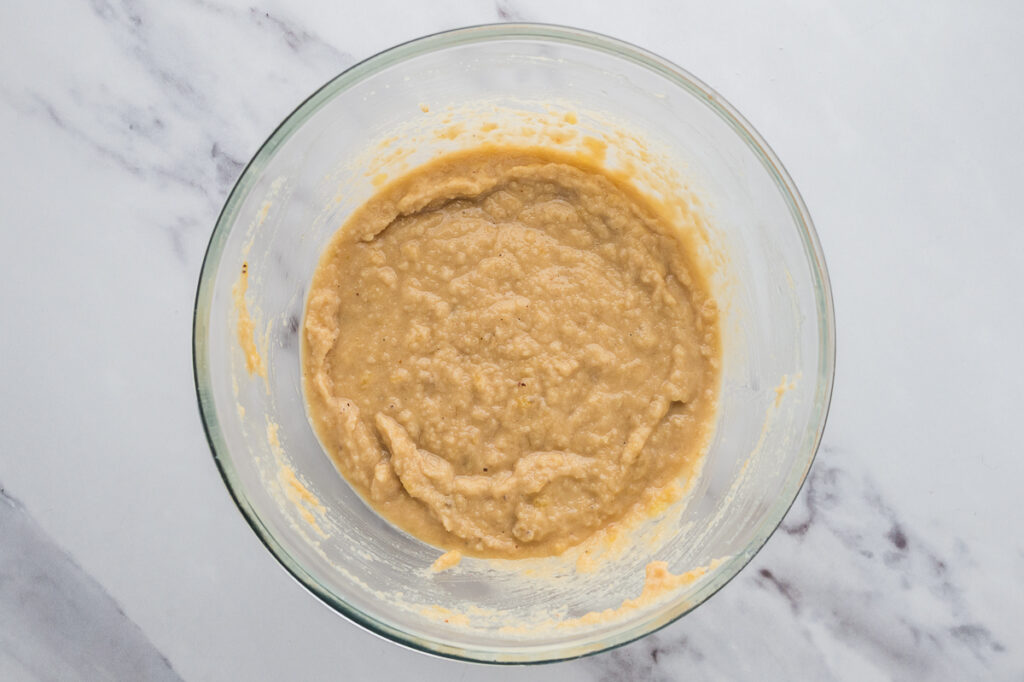
Add the almond flour, baking powder, baking soda, and salt directly into the same bowl. Stir until a thick, smooth batter forms. Be careful not to overmix. You just want all the dry ingredients evenly incorporated.
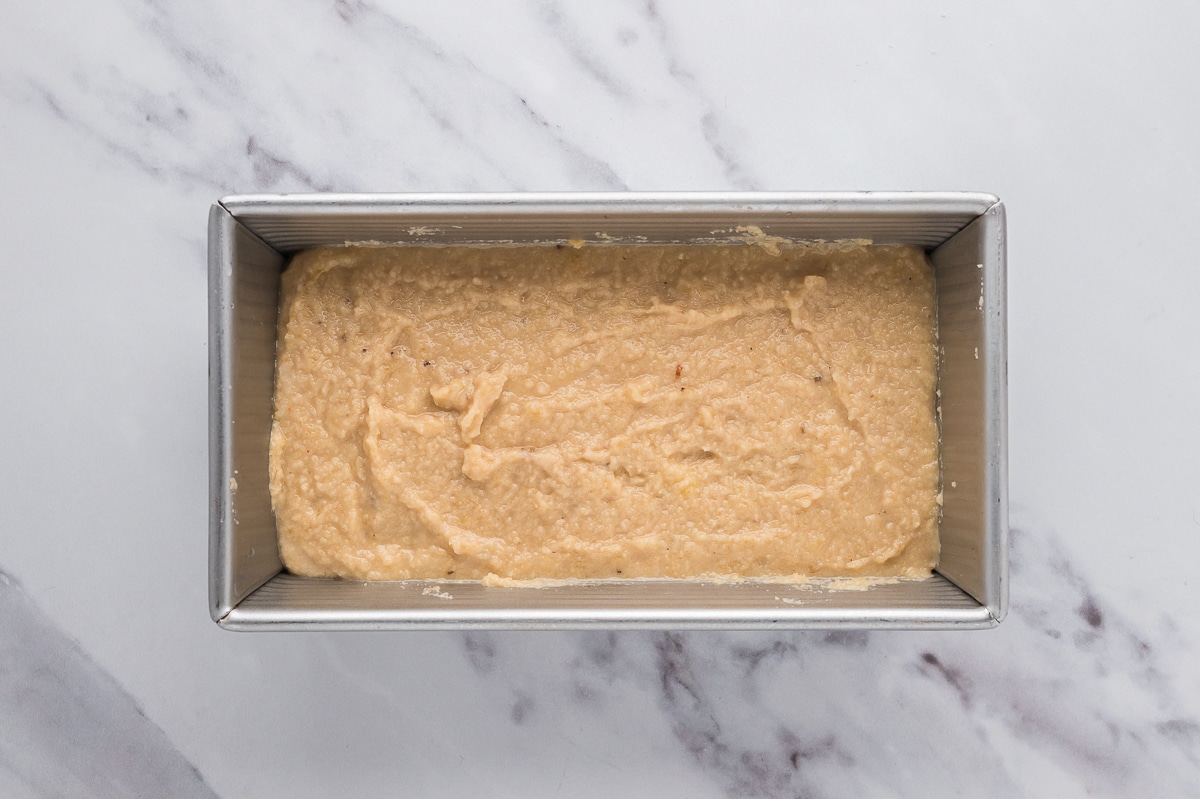
Pour the batter into the prepared loaf pan and smooth the top with a spatula.
Bake for 40 to 50 minutes, or until the top is golden brown and a toothpick inserted into the center comes out clean. If the top begins to brown too quickly, loosely cover with foil for the last 10 to 15 minutes of baking.
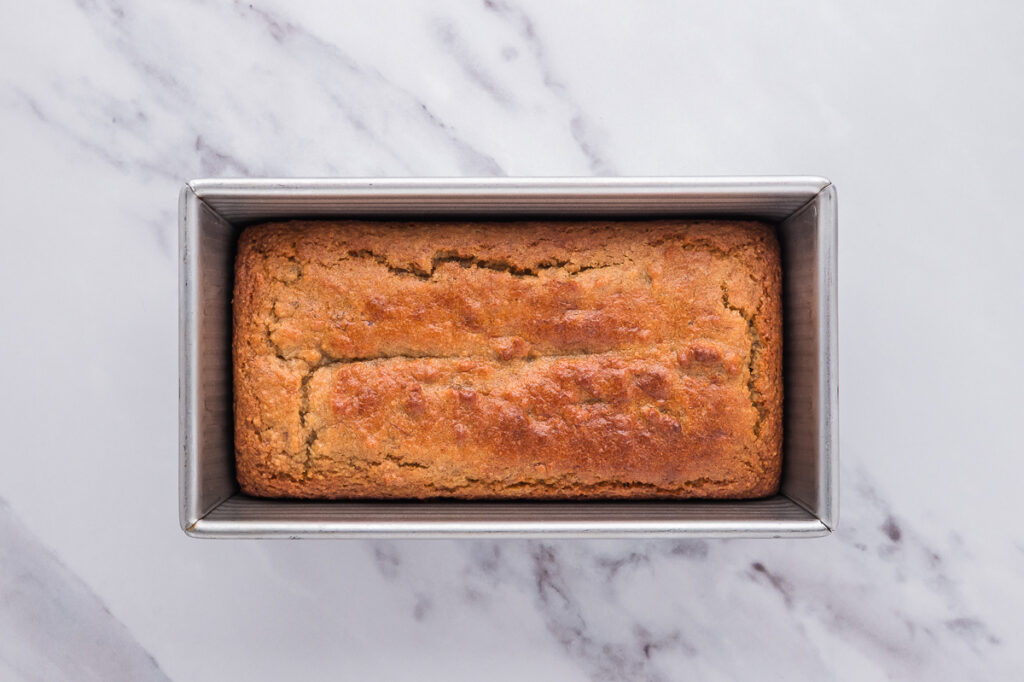
Let the bread cool in the pan for 10 to 15 minutes, then transfer to a wire rack to cool completely before slicing. Use a serrated knife for the cleanest cuts. Almond flour banana bread is delicate when warm, so give it time to firm up.
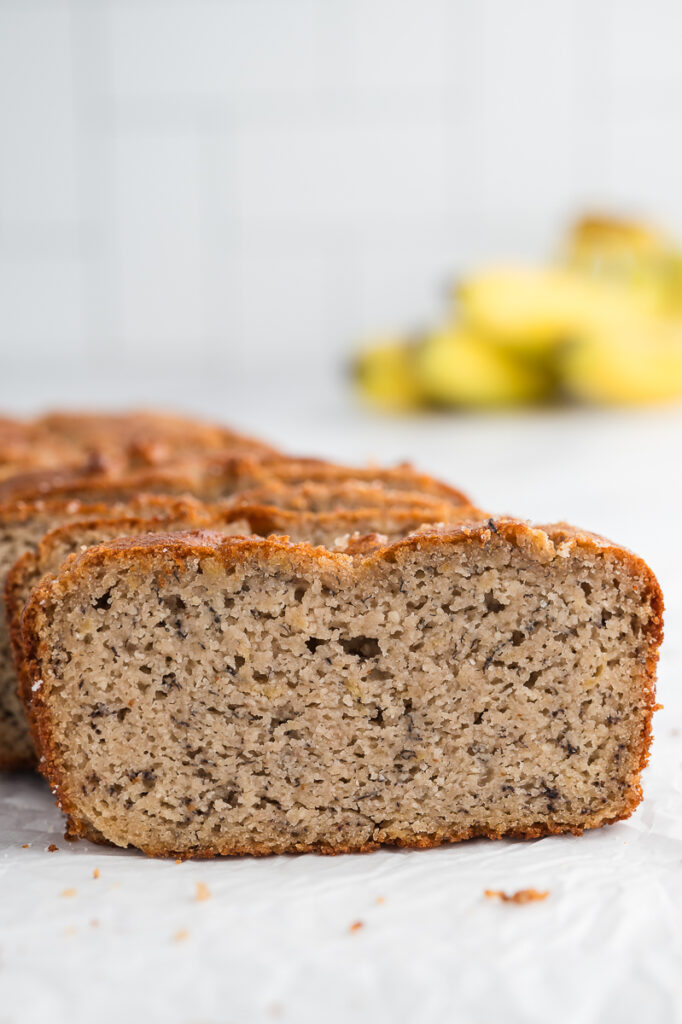
Tips for the Best Almond Flour Banana Bread
Banana bread is one of those recipes that is easy to make, but small details matter. These tips come from multiple rounds of testing in our kitchen.
- No need to let the batter rest. In our almond flour muffins recipe, we let the batter rest. For this recipe, it is not necessary. Pour and bake right away.
- Use a kitchen scale for the almond flour. Almond flour can vary significantly depending on how you measure it. A scale removes the guesswork. If you do not have a scale, use the spoon-and-level method described above.
- Use ripe bananas. Brown-spotted bananas are sweeter and more moist. If your bananas are not ripe enough, the bread will be bland and dry. I keep a supply of overripe bananas in the freezer for exactly this reason.
- Do not overmix the batter. Stir until the flour is incorporated and stop. Overmixing can compress the batter and limit how much the bread rises.
- Use a metal pan. Metal loaf pans conduct heat more efficiently than glass or ceramic. Glass pans can cause the center to stay underdone while the edges overbake.
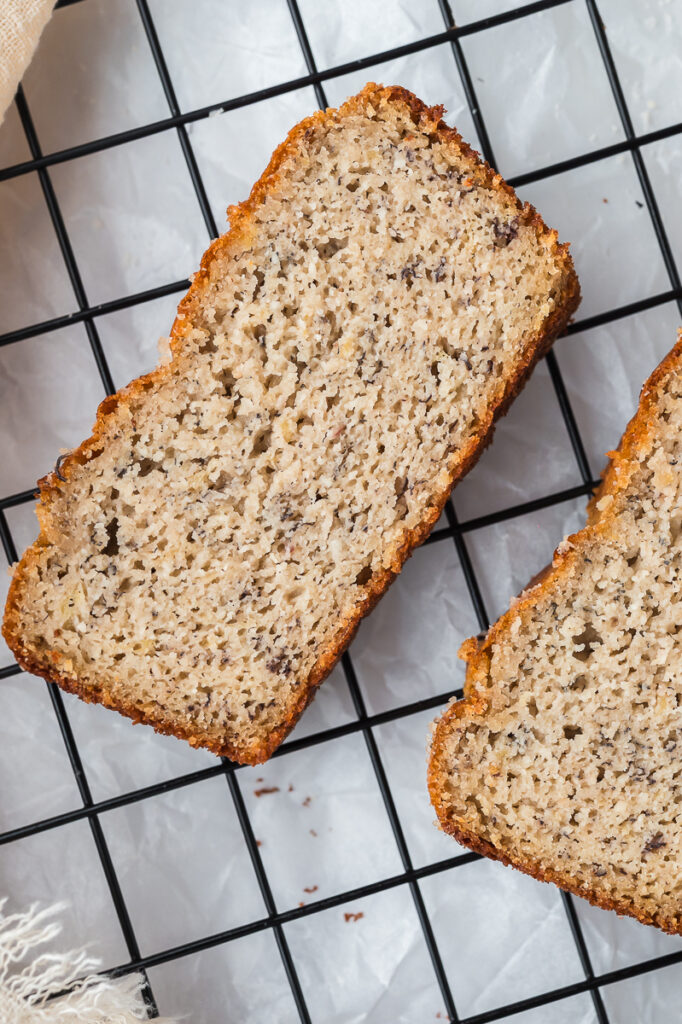
Troubleshooting
We have tested this recipe enough times to know what can go wrong and why. If your bread did not turn out the way you expected, check these common issues.
Why Is My Banana Bread Gummy?
Banana bread can turn out gummy when there is too much moisture or the structure is not strong enough to support the batter.
- Too much banana. Adding extra mashed banana increases the moisture and can make the center dense and wet. Measure your bananas after mashing for the best accuracy.
- Undercooked center. If the bread is not baked long enough, the middle can stay soft and gummy even if the outside looks done. Always check with a toothpick inserted into the center.
- Too much liquid. Extra oil or sweetener can throw off the balance and lead to a heavy, wet texture.
- Not enough structure. Almond flour does not contain gluten, so the bread relies on eggs and leavening for structure. If these are reduced or measured incorrectly, the bread may not set properly.
- Slicing too soon. Almond flour banana bread needs time to cool and firm up. Cutting it while still warm can make it seem gummy even if it is fully baked. Wait until it reaches room temperature.

Why Is My Banana Bread Not Rising?
Banana bread may not rise properly if the leavening is not strong enough or the batter is too heavy.
- Old or inactive baking soda or baking powder. If your leavening agents are expired, they will not create enough lift and the bread will stay flat. Test your baking soda by adding a splash of vinegar. If it fizzes, it is still active.
- Too much moisture. Adding too much banana or liquid can weigh down the batter and prevent it from rising.
- Not enough leavening. Almond flour is naturally heavier than wheat flour, so it relies on the correct balance of both baking soda and baking powder to rise.
- Overmixing the batter. Overmixing can make the batter dense and limit how much it rises in the oven.
- Oven temperature too low. If the oven is not fully preheated or runs cooler than the dial reads, the bread may not rise properly during baking. An oven thermometer can help you confirm accuracy.
Why Is My Almond Flour Banana Bread Falling Apart?
Almond flour banana bread can fall apart because it does not contain gluten, which normally helps hold baked goods together.
- Not enough eggs. Eggs are the main binding ingredient in this recipe. If there are not enough eggs, the bread will not hold its shape and may crumble when sliced.
- Too much banana. Extra banana adds moisture that can weaken the structure, making the bread too soft to hold together.
- Undercooked center. If the bread is not fully baked, the inside will be too soft and may fall apart when sliced.
- Not cooled properly. Almond flour banana bread needs time to set. Slicing while still warm can cause it to break or crumble.
- Using almond meal instead of almond flour. Almond meal is coarser and includes the skins, which results in a more fragile texture compared to finely ground blanched almond flour.

How to Store and Freeze Almond Flour Banana Bread
Our family goes through banana bread quickly, but I almost always make extra loaves to freeze. Here is how to keep it fresh at every stage.
Store leftovers at room temperature for up to 2 days in an airtight container. Because almond flour contains natural oils, the bread stays moist but can spoil faster than traditional wheat-based banana bread.
For longer storage, place the banana bread in an airtight container in the fridge, where it will keep well for up to 5 days. Let it come to room temperature before serving, or warm individual slices for the best texture. We like to pop slices in the toaster and then spread on butter or almond butter.
To freeze, let the banana bread cool completely first. You can freeze the whole loaf or slice it for convenience (slicing first is faster for grab-and-go breakfasts). Wrap tightly in plastic wrap or parchment paper, then place in a freezer-safe bag or airtight container. Freeze for up to 3 months.
When ready to eat, thaw at room temperature or warm slices in the microwave for 20 to 30 seconds until heated through.
Variations
Take the base recipe and make it your own. These are the variations we have tested and can vouch for. If you are looking for more almond flour recipes, we have a full collection.
No Sugar or Naturally Sweetened Version
The base recipe is already naturally sweetened with bananas and maple syrup (or honey). If you want to reduce the sugar further, replace the maple syrup with an equal amount of monk fruit sweetener or erythritol. You may need to add 1 to 2 tablespoons of extra oil or milk to compensate for the lost moisture, since liquid sweeteners also contribute liquid to the batter.
Vegan Version
Replace the eggs with flax eggs. Mix 3 tablespoons ground flaxseed with 9 tablespoons water and let it sit for 5 to 10 minutes until thickened. The texture will be slightly softer and denser, but still moist and delicious. Increase the baking powder to about ¾ teaspoon to help with lift, since flax eggs do not provide the same structure as whole eggs.
Chocolate Chip Version
Follow the base recipe and fold in ½ cup (85 g) of gluten-free chocolate chips just before pouring the batter into the loaf pan. Mini chips distribute more evenly through the batter than standard-size chips.
Banana Nut Version
Follow the base recipe and fold in ½ cup (50 to 60 g) chopped walnuts or pecans just before pouring the batter into the loaf pan. Stir the nuts gently so they distribute evenly. You can also sprinkle a few extra chopped nuts on top before baking for a more bakery-style finish and added crunch.
Blueberry Banana Bread
Fold in ¾ cup of fresh blueberries just before pouring the batter into the pan. Toss the blueberries in a tablespoon of almond flour first to help prevent them from sinking to the bottom during baking. Frozen blueberries also work, but do not thaw them before adding to the batter or they will release too much juice.
Muffin Conversion
Pour the batter into a lined muffin tin instead of a loaf pan for individual portions. Bake at 350°F for 18 to 22 minutes, or until a toothpick inserted in the center comes out clean. This makes about 10 to 12 muffins depending on size. For a full muffin recipe, try our Gluten-Free Banana Muffins.
What Not to Add
A few add-ins do not work well in this recipe. Apples contain too much moisture and can make the batter heavy, preventing it from baking through properly. If you want fruit in the bread, stick with blueberries or sliced strawberries, which release less liquid during baking.
Almond Flour vs. Almond Meal vs. Other Flours
This is one of the most common questions we get, so here is a quick comparison.
Blanched almond flour is made from almonds with the skins removed, then ground into a fine powder. It produces the lightest, softest crumb and is what this recipe is written for.
Almond meal is ground from whole almonds with the skins still on. It works in a pinch, but expect a denser texture, darker color, and slightly grittier crumb. The bread is also more likely to crumble.
Coconut flour cannot be swapped 1:1 for almond flour. Coconut flour absorbs significantly more liquid, so you would need to reduce the amount by about 75% and add extra eggs. I do not recommend substituting coconut flour in this recipe without a tested ratio. If coconut flour is your preferred flour, try our Paleo Banana Bread instead, which is formulated for a different flour base.
Gluten-free flour blend will produce a completely different texture and rise. If you prefer a blend, our Gluten-Free Banana Bread is the better recipe for you.
What to Serve With Almond Flour Banana Bread
This banana bread goes down well with a cup of coffee or a refreshing Strawberry Pineapple Smoothie in the warmer months.
We also like to set out a brunch spread with breakfast casseroles, quiche, and some sweet items. Banana bread sliced and lightly toasted with butter or almond butter is one of our favorite ways to eat leftovers the next morning.
Yes, this almond flour banana bread is paleo when made with honey or maple syrup and a paleo-friendly oil such as avocado oil or coconut oil. The recipe is grain-free, dairy-free (with oil), and uses no refined sugar.
You can use almond meal, but it will change the texture. Almond meal is coarser and includes the almond skins, so the bread will be denser, darker, and slightly more gritty. For the best results and a softer crumb, blanched almond flour is the right choice.
Yes, almond flour works well for banana bread. It creates a soft, moist texture with a slightly nutty flavor. The key difference from regular flour is that almond flour needs eggs (or a tested egg replacer) and proper leavening to give the bread structure and help it rise, since there is no gluten to do that job.
A typical slice of almond flour banana bread has roughly 10 to 14 grams of total carbs, depending on the size of your slice and how much sweetener you use. That is lower than traditional banana bread made with all-purpose flour, which can be 25 to 30 grams per slice. For an even lower-carb version, use a sugar-free sweetener like monk fruit or erythritol in place of the maple syrup.
This recipe is lower in carbs than traditional banana bread, but it is not strictly keto because of the natural sugars in the bananas and the maple syrup. If you follow a keto diet, you can reduce the carbs by using only two bananas instead of three, replacing the maple syrup with a sugar-free sweetener, and keeping your serving size smaller.
Coconut flour cannot be substituted 1:1 for almond flour. It absorbs much more liquid, so you would need significantly less coconut flour and more eggs. I do not recommend making that swap in this recipe. If coconut flour is what you have on hand, try our Paleo Banana Bread instead.
Yes, you can make a vegan version using flax eggs. Mix 3 tablespoons ground flaxseed with 9 tablespoons water and let it sit for 5 to 10 minutes until it thickens into a gel. The bread will be slightly softer and denser, but still moist and flavorful. Increase the baking powder to ¾ teaspoon to help compensate for the lost lift.
Store at room temperature in an airtight container for up to 2 days, or in the fridge for up to 5 days. For longer storage, wrap tightly and freeze for up to 3 months. Thaw at room temperature or warm slices in the microwave for 20 to 30 seconds.
The most common causes are too much almond flour (measure carefully using the spoon-and-level method or a kitchen scale), expired leavening agents, or overmixing the batter. Make sure your baking soda and baking powder are still active, and stir the batter only until the ingredients are just combined.
Frequently Asked Questions
Is this almond flour banana bread paleo?
Can I use almond meal instead of almond flour?
Will almond flour work for banana bread?
How many carbs are in almond flour banana bread?
Is almond flour banana bread keto?
Can I use coconut flour instead of almond flour?
Can I make this banana bread without eggs?
How do I store almond flour banana bread?
Why does my almond flour banana bread taste too dense?
Almond Flour Banana Bread

This almond flour banana bread is soft, moist, and full of natural banana flavor with a tender crumb. It’s an easy one-bowl recipe that’s naturally gluten-free, grain-free, dairy-free (with the right oil), and paleo-friendly.
Ingredients
- 2 cups almond flour (224 g)
- 3 large eggs (150 g)
- ¾ cup mashed ripe banana (165 g)
- 3 tablespoons oil (45 g) avocado oil, melted coconut oil, or light olive oil
- 2 tablespoons honey or maple syrup (38 g)
- ½ teaspoon baking soda (2.5 g)
- ½ teaspoon baking powder (2 g)
- ¼ teaspoon salt (1.5 g)
- 1 teaspoon vanilla extract (5 g)
Instructions
- Preheat your oven to 350°F (175°C) or 160°C fan-forced. Line a standard loaf pan with parchment paper or lightly grease it.
- In a large mixing bowl, add the ripe bananas and mash them until mostly smooth with a few small lumps remaining.
- Add the eggs, oil, maple syrup (or honey), and vanilla extract. Whisk everything together until well combined and smooth.
- Add the almond flour, baking powder, baking soda, and salt directly into the same bowl. Stir until a thick, smooth batter forms. Be careful not to overmix.
- Pour the batter into the prepared loaf pan and smooth the top with a spatula.
- Bake for 40–50 minutes, or until the top is golden brown and a toothpick inserted into the center comes out clean. If the top begins to brown too quickly, loosely cover with foil for the last 10–15 minutes.
- Let the bread cool in the pan for 10–15 minutes, then transfer to a wire rack to cool completely before slicing.
Notes
- No need to let the batter rest. It is not necessary for this recipe.
- Use a kitchen scale for the almond flour. I like to use a kitchen scale for better accuracy.
- Use ripe bananas. Use ripe bananas that have brown spots on them.
- Do not overmix the batter. All you want to do is make sure all the ingredients are evenly distributed.
Recommended Products
As an Amazon Associate and member of other affiliate programs, I earn from qualifying purchases. They never cost you extra.


Nutrition Information:
Yield:
12Serving Size:
1Amount Per Serving: Calories: 313Total Fat: 25gSaturated Fat: 5gUnsaturated Fat: 20gCholesterol: 47mgSodium: 154mgCarbohydrates: 14gFiber: 6gSugar: 5gProtein: 11g
This nutrition info is based on the exact ingredients and brands used at the time. It may not be 100% accurate. Please check your ingredients nutrition labels.
More Gluten-Free Banana Bread Recipes
If you love this recipe, here are a few more of our favorite banana bread recipes to try next:
- Paleo Banana Bread
- Gluten-Free Banana Bread
- Gluten-Free Coconut Pecan Banana Bread
- Easy Gluten-Free Chocolate Banana Bread
If you make this almond flour banana bread recipe, please stop by and let me know what you think. Your feedback helps other readers find recipes they can trust.
DID YOU MAKE THIS RECIPE?
Tag @glutenfreepalate on Instagram and hashtag it #glutenfreepalatebaker so we can see all the deliciousness!




Leave a Question or Comment